What Is the Best Artificial Grass for Dogs? An Australian Buyer's Guide
3 September 2026
Share this article
Last updated
·10 min read
The best artificial grass for dogs is the one matched to how many dogs you have and how hard they are on the yard, laid over a base that drains. Drainage and durability decide whether a pet lawn works. Appearance decides almost nothing.
A1SGS recommends three products for pet areas, and which one suits you comes down to breed, numbers and traffic rather than budget alone.
What Actually Matters Here
Drainage decides odour, not the fibres.
Synthetic yarn does not absorb urine. Smell comes from residue sitting in the infill and base, which is a groundworks problem rather than a product problem.
Three products, three different dogs.
Summer Elite 35mm for one or two dogs, Endurance30 30mm for multi-pet and high-traffic areas, Multisports 14mm for enclosures and kennel floors.
Surface heat is the real safety issue.
Synthetic surfaces measured 70 to 75 degrees on hot Western Sydney days against 37 degrees for irrigated natural grass. Dogs walk on it barefoot.
Edges matter as much as the turf.
A dog cannot dig through synthetic grass, but it can lift an edge. Secure edges and a compacted base are what stop that.
Infill is a choice, not a default.
A1SGS installs either silica sand or an antimicrobial infill in pet areas. Ask which one is in your quote.
It is low maintenance, not maintenance free.
Pick up solids the same day and rinse the spots your dog actually uses.
What Makes Turf Suitable for Dogs?
Four things, in this order: drainage, fibre durability, secure edges and heat.
Everything else on a spec sheet matters less than people expect.
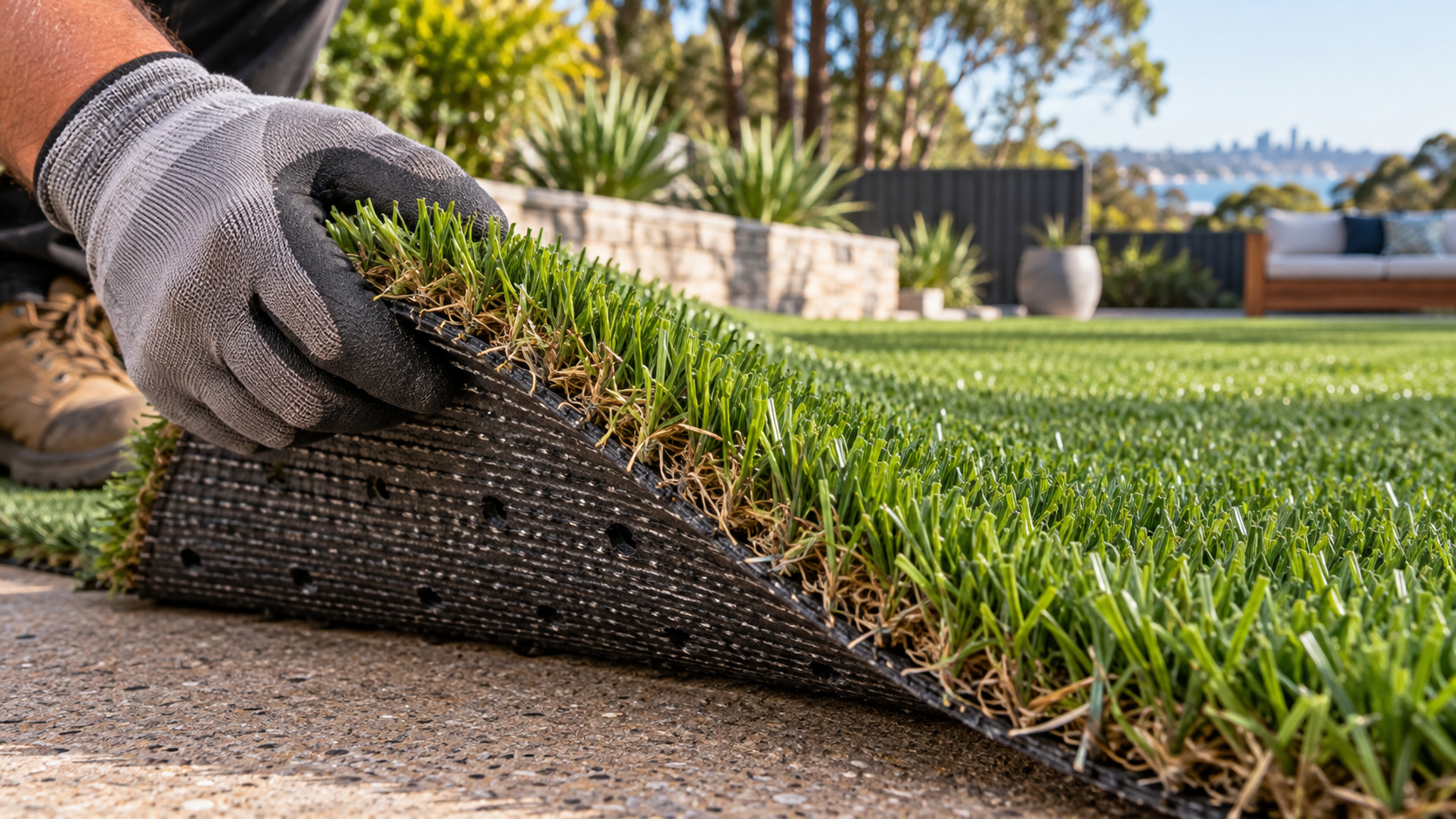
A permeable backing and a free-draining base.
Liquid has to leave the system rather than sit in it. This is decided at installation and cannot be retrofitted without lifting the lawn.
Fibre that recovers.
Dogs run the same line every day. Soft yarn flattens along that line and stays flat, while stiffer, denser fibre stands back up.
Reinforced edges and a compacted sub-base.
The failure point on a pet lawn is almost always an edge that has been worried loose, not the middle of the turf.
UV-stabilised yarn.
Non-negotiable in Australian conditions, and standard across the A1SGS range.
An infill suited to pet use.
Silica sand or an antimicrobial infill, depending on the area and how heavily it is used.
Softness is not the same as suitability.
The softest turf in a range is usually the one that flattens fastest under a dog. For a yard a dog actually uses, wear resistance and drainage will give you a better result in three years than a plusher pile will.
A1SGS turf is PFAS-free and independently tested, and the same products are installed in commercial animal facilities including Hamilton Veterinary Clinic and Kurri Kurri Boarding Kennels. A boarding kennel is a harder test than any backyard.
Which A1SGS Products Suit Which Dogs?
Recommended turf products for pet areas
Product
Pile
Best for
Summer Elite
35mm
Single or dual dog households and family backyards. Realistic and soft underfoot.
Endurance30
30mm
Multi-pet or high-traffic zones, kennels and large breeds. Six-fibre construction.
Multisports
14mm
Dedicated pet enclosures, dog runs and kennel flooring. Low pile, easy to hose out.
Endurance30 is the honest answer for most working dog households.
If you have two dogs, a large breed, or one dog with more energy than sense, the extra fibre density is what stops a worn line appearing along the fence within a season.
Summer Elite is the better call when the lawn is on show.
One gentler dog and a backyard people sit in is exactly what it is built for, and it looks more like a lawn than Endurance30 does.
Multisports is not a lawn.
At 14mm it is short and dense, which makes it ideal for a run or a dedicated toilet area you want to hose out, and wrong for a yard you want to look green and soft.
Compare the full range through Urban Turf Solutions, the manufacturer A1SGS sources from.
Does Dog Urine Damage Artificial Grass?
No, and that is the main advantage over a natural lawn.
Urine burns natural grass because the nitrogen concentration kills the plant, which is where yellow patches come from. Synthetic fibre is not alive and does not absorb liquid, so it does not discolour or die back.
What urine causes is odour, and that happens below the surface.
Urea residue settles into the infill and the base. Where liquid drains away quickly it gets flushed out with every rinse and every rainfall. Where it sits, it accumulates, and warm weather makes it obvious.
So the question is never whether your turf resists urine. It is whether your installation lets urine leave.
Three things decide that,
and all three are installation decisions: a permeable backing, an infill that does not hold residue, and a compacted base that drains. A1SGS builds the sub-base and drainage before the turf goes down, and installs a weed membrane that blocks growth while still letting liquid through.
If your yard already holds water after rain, it will hold urine too.
That is the single most common cause of a pet lawn that smells within a year, and it needs solving at the excavation stage rather than afterwards.
Surface Heat and Your Dog's Paws
This is the part most pet turf pages skip, and it deserves a number.
The NSW Department of Planning's guideline on synthetic turf reports that on very hot summer days in Western Sydney, synthetic surfaces reached average surface temperatures of 70 to 75 degrees, against 37 degrees for irrigated natural grass. Agriculture Victoria's guidance on heat and pets warns that because a dog is much closer to the hot ground, its body heats up quickly and its paws can sustain burns or injuries.
This is true of all synthetic turf, from every supplier.
A living lawn cools itself by evaporating water. Turf cannot, so on an exposed day it will be hotter underfoot than the grass it replaced. Anyone who tells you otherwise is selling.
What actually keeps a dog comfortable:
Shade over part of the lawn,
which does more than any product specification. Plan it in at the same time as the turf, not afterwards.
A quick hose down
before the dog goes out on a hot afternoon.
Timing.
Early morning and evening, as Agriculture Victoria recommends.
The back of your hand on the surface for five seconds.
If you cannot hold it there, neither can your dog.
If your yard faces north or west with no shade at all, raise it during the site consultation. It changes where the turf should go.
How Do You Clean and Maintain Artificial Grass for Dogs?
The routine is short, and doing it consistently beats an occasional deep clean.
Pet turf maintenance schedule
How often
What to do
Daily
Remove solid waste and clear debris
Weekly
Hose down the surface, concentrating on the spots your dog actually uses
Monthly
Apply a diluted, pet-safe cleaning solution
Quarterly
Brush the fibres upright in high-traffic areas
Annually
Inspect the sub-base, edges and infill, and top up infill where it has thinned
Frequency follows the yard, not the calendar.
One small dog on a large lawn in a wet month may need almost nothing. Three large dogs in a courtyard in February need attention every few days. Watch the two or three patches your dog reuses and let those set the pace.
Central Coast Council's responsible pet ownership guidance makes picking up after your dog an obligation in public places and on other people's property. On your own lawn it is not a legal requirement, but it is the single habit that most affects whether the surface stays fresh.
Is Artificial Grass for Dogs Better Than Natural Grass?
Artificial and natural grass compared for dog owners
Factor
Artificial
Natural
Urine
No discolouration, needs drainage and rinsing
Yellow patches and dead spots
Wear paths
Suitable products recover, softer ones flatten
Worn to dirt along the run line
Mud
None
Reliably, after every wet week
Digging
Cannot be dug through, but edges can be lifted
Dug easily
Fleas and ticks
No soil habitat for them to live in
Soil can harbour them
Surface heat
Considerably hotter in full sun
Cooler, self-evaporating
Upkeep
Pick up, rinse, brush
Mow, water, fertilise, repair
Where artificial grass genuinely wins for dog owners:
the worn strip along the fence, the bare patch by the back door, and the mud that follows a dog inside. Those are the three things dog owners actually complain about, and turf solves all three.
Where it does not:
a fully exposed yard with no shade, where a natural lawn stays cooler underfoot through summer.
Digging, Edges and Fence Lines
A dog cannot dig through synthetic grass. It can lift an edge.
That is the failure mode worth designing against, and it is entirely an installation question.
What holds up: a properly compacted sub-base, precision-cut turf with secure joins, and fixed perimeter edging. A1SGS specifies dig-resistant construction with reinforced sub-base and secure edges for exactly this reason.
Fence lines deserve attention while the yard is open.
Central Coast Council's guidance is that a dog should not be able to get over, under or through a fence or gate. The moment you are excavating along a fence line is the cheapest moment you will ever have to fix a gap underneath it.
Dogs that dig at edges usually do it in one or two spots, most often where they can see or hear something on the other side. Solving the sight line often solves the digging.
How Do You Choose for Your Dog and Your Backyard?
Count the dogs and be honest about size and energy.
Two large active dogs is a different specification from one small one.
Walk the existing lawn and find the wear paths.
Those lines tell an installer where the turf will take the most punishment.
Watch how the yard drains after rain.
If it puddles now, budget for drainage work rather than hoping.
Pick the product by use, not appearance.
Endurance30 for hard use, Summer Elite for a family lawn, Multisports for a run.
Ask which infill is in the quote,
silica sand or antimicrobial, and why.
Plan the shade
if the yard faces north or west.
Check the base is itemised.
Almost every failed pet lawn is a base failure, so a quote that glosses over the groundworks is the one to question.
Typical residential pet installations run from around 40 to 400 square metres, and A1SGS assesses the site before recommending a product. For apartment complexes, shared pet areas, kennels or doggy daycares, commercial artificial grass installation
is the more relevant starting point than a standard residential build. For a backyard, residential artificial grass installation
covers the ground preparation and product selection.
If you are still costing the project, the guide to what artificial turf costs
covers the factors that move a quote.
Frequently Asked Questions
What is the best artificial grass for dogs?
The one matched to your dogs rather than the one that looks best in a photograph. A1SGS recommends Summer Elite 35mm for single or dual dog households and family backyards, Endurance30 30mm for multi-pet homes, large breeds and high-traffic zones, and Multisports 14mm for dedicated runs, enclosures and kennel flooring. Across all three, drainage and base preparation affect how the lawn performs more than the product choice does.
Is artificial grass safe for dogs?
A1SGS pet turf is PFAS-free, non-toxic and independently tested, and the same products are installed in veterinary and boarding facilities. It also removes the soil habitat that fleas and ticks live in, and the pesticides and fertilisers a natural lawn needs. The practical safety issue is surface heat rather than the material: synthetic surfaces run far hotter than natural grass in direct sun, and Agriculture Victoria warns that a dog's paws can sustain burns on hot ground, so shade and timing matter.
Does dog urine damage artificial grass?
No. Urine kills natural grass because of nitrogen concentration, which is what causes yellow patches, but synthetic fibre is not alive and does not absorb liquid, so it does not discolour or die back. What urine can cause is odour, and that comes from urea residue in the infill and base rather than the fibres. Good drainage flushes it away with every rinse and rainfall, and poor drainage lets it accumulate.
How do you stop artificial grass smelling like dog urine?
Drainage first, routine second, product third. Liquid has to leave the system, which is decided by the backing, the infill and the base at installation. Then pick up solids the same day and hose the spots your dog reuses, since dogs return to the same two or three patches. A monthly rinse with a diluted pet-safe cleaner handles residue in high-use areas. No cleaner will fix a lawn that cannot drain.
Will my dog dig up artificial grass?
A dog cannot dig through synthetic turf, but it can lift a loose edge, which is why perimeter fixing and sub-base compaction matter more than the turf specification on this point. A1SGS uses reinforced sub-base preparation and secure edges to resist exactly this. Dogs that dig usually target one or two spots along a fence where they can see or hear something, so blocking the sight line often stops the behaviour.
Get a Yard That Survives Your Dog
Tell us how many dogs, what breeds, how hard they are on the yard and how it drains, and you will get a product recommendation rather than a catalogue.
Find out is turf hotter than grass during Australian summers and learn simple ways to reduce surface heat. Choose suitable turf with help from an expert.
Explore synthetic turf for dogs Australia homeowners can rely on. Compare drainage, comfort and durability, then request advice for a pet-friendly lawn.
Learn what is synthetic grass made of, how material performs and which option suits your yard. Compare durable turf products and request expert advice.
Compare types of artificial grass turf for pets, families and high-traffic yards. Explore features, costs and uses to choose the right lawn for your home.
The fall heights, impact areas and standards that govern playground soft fall, and how synthetic grass with a shock pad compares with rubber and loose fill.