
What Is Synthetic Grass Made Of? Materials Explained
Synthetic grass materials guide · 14 min read
Synthetic grass is generally made from plastic fibres attached to a layered backing system. If you have ever wondered what synthetic grass is made of, the short answer is that the visible blades are usually polyethylene, polypropylene or nylon. At the same time, the backing beneath them typically combines a polypropylene fabric with a latex or polyurethane coating.
The exact materials vary by product, and manufacturers adjust the yarn, backing, and coating to suit the intended use. A residential lawn turf, a pet-friendly product, a putting surface and a high-traffic commercial turf can each use different yarns, densities and backing systems suited to their specific job, so the same three base polymers can end up performing quite differently depending on how they are engineered.
Synthetic grass is a manufactured ground covering made from polymer fibres that are tufted into a backing system to imitate the appearance and function of natural grass.
You might also see this product called by other names. What is artificial grass called elsewhere? Artificial grass, synthetic grass and synthetic turf generally describe the same category of manufactured surface, and the terms are used interchangeably across Australia. “Fake grass” is an informal term for the same thing. AstroTurf is a well-known brand name that some people use generically, but it is not the technical name for every synthetic grass product on the market.
In This Guide
- What Materials Is Synthetic Grass Made Of?
- What Are the Main Components of Synthetic Grass?
- Is Synthetic Grass Made From Plastic?
- What Types of Materials Are Used in Synthetic Grass Blades?
- How Are Synthetic Grass Backing and Fibres Manufactured?
- How Do Materials Affect Synthetic Grass Quality and Durability?
- Environmental and End-of-Life Considerations
- Ready to Compare Your Options?
- Frequently Asked Questions
What Materials Is Synthetic Grass Made Of?
Synthetic grass is usually made from polyethylene, polypropylene, nylon or a combination of these polymers. A complete turf product also includes one or more backing layers, a secondary coating and, in some installations, infill.
The visible grass blades are only one part of the finished product. Manufacturers combine different materials to balance softness, resilience, price, appearance and the intended application, so two products that look similar on a sample board can be built quite differently underneath.
| Component | Common Materials | Main Function | What Buyers Should Check |
|---|---|---|---|
| Grass blades | Polyethylene, polypropylene or nylon | Create the visible lawn surface | Softness, resilience, blade shape and UV stabilisation |
| Thatch fibres | Polypropylene or polyethylene | Add density and support the upright blades | Density, colour variation and recovery |
| Primary backing | Woven or non-woven polypropylene and related fabrics | Holds the tufted yarn | Dimensional stability and tuft retention |
| Secondary coating | Polyurethane, latex or another product-specific compound | Secures the fibres to the backing | Bond strength, flexibility and drainage design |
| Infill | Sand, rubber, mineral or organic materials, depending on the system | Supports blades and can add weight or cushioning | Suitability for the application and maintenance needs |
| Seaming materials | Adhesive and joining tape | Connect separate turf sections during installation | Compatibility with the turf and site conditions |
The Synthetic Turf Council describes primary backing as typically a woven or non-woven fabric in one or more layers, with a secondary coating of polyurethane, latex or a similar compound applied underneath to lock the tufted fibres in place.
Adhesives, joining tape and some infill products are installation materials rather than part of the manufactured turf roll itself. It pays to check whether a quoted price covers the complete system or the turf alone, something our product range sets out product by product.
What Are the Main Components of Synthetic Grass?
Most synthetic grass is built as a layered system. The visible yarn provides appearance and surface performance, while the layers beneath hold the fibres in place and help the finished product remain stable over years of use.
Working from the surface down, a typical system includes:
- Grass blades or face fibres
- Curled thatch fibres
- Primary backing
- Secondary backing or coating
- Drainage holes or permeable backing
- Optional infill
- Prepared installation base
The compacted base beneath the turf is part of the installed system on site, but it is not part of the turf product manufactured in the factory. This distinction matters when comparing warranties, since a product warranty on the turf and a workmanship warranty on the base and installation usually cover different things.
| Layer | Where It Sits | What It Does |
|---|---|---|
| Face yarn | Top of the surface | Creates the colour, texture and grass-like appearance |
| Thatch | Beneath and between the main blades | Adds body and helps support the facial fibres |
| Primary backing | Behind the yarn | Provides the fabric through which the yarn is tufted |
| Secondary coating | Applied to the underside | Locks the tufted fibres into place |
| Drainage system | Within or through the backing | Allows water to move through or away from the turf |
| Infill | Brushed between the fibres | Supports the blades and may add stability or cushioning |
| Base | Beneath the turf | Provides drainage, stability and a smooth finished surface |
Some turf uses perforated drainage holes at set intervals, while other products use a more broadly permeable backing. It is worth confirming which drainage design a specific product uses rather than assuming every synthetic grass system drains the same way, particularly for pet-friendly applications where liquid needs to clear quickly.
Is Synthetic Grass Made From Plastic?
Yes. Most synthetic grass is primarily made from plastic polymers, especially polyethylene, polypropylene and nylon. Its backing and coating may also contain polymer-based materials.
Manufacturers use plastic because polymer yarn can be shaped into thin, flexible fibres that resist moisture and retain their colour and form when exposed to the elements. Additives and pigments are often introduced during manufacturing to produce colour, aid processing, or improve resistance to ultraviolet light from the sun.
It is worth weighing the limitations alongside the benefits. Synthetic grass does not biodegrade the way natural grass does; it can become hot in direct sun, and it may shed small amounts of fibre or infill as it wears. End-of-life recycling can also be difficult, because a finished product typically combines several different materials that are hard to separate. CSIRO research into advanced plastics recycling notes that mixed, multi-layer, or contaminated plastics are among the hardest waste streams to recover using standard recycling methods.
| Characteristic | Potential Benefit | Limitation or Question to Check |
|---|---|---|
| Moisture resistance | Fibres do not rot like natural plant matter | Drainage and backing still need correct installation |
| Consistent appearance | Pigments create a stable, manufactured colour | Fading resistance varies by product and exposure |
| Low mowing requirement | The surface does not need mowing | Cleaning, brushing and repairs may still be required |
| Polymer construction | Supports flexible, repeatable yarn shapes | Plastic components do not readily biodegrade |
| Material blends | Can combine softness, resilience and support | Mixed materials may complicate recycling |
Being described as plastic does not, by itself, establish a product’s quality or suitability. Buyers need to evaluate the complete specification, the backing and coating used, and the installation system, not just whether a product is made of polymer.
What Types of Materials Are Used in Synthetic Grass Blades?
Polyethylene is widely used for soft, grass-like residential surfaces. Polypropylene is commonly used in thatch, backing and some specialised or lower-cost fibres. Nylon, also called polyamide, is generally selected where stiffness and resilience are priorities.
Polyethylene
Polyethylene is a common choice for residential landscaping because it can be formed into flexible, relatively soft fibres. It comes in different blade shapes, colours and thicknesses.
Not every polyethylene product performs the same way. Durability also depends on fibre thickness, density, blade shape, manufacturing quality and how well the fibre is stabilised against UV exposure.
Polypropylene
Polypropylene is lightweight and versatile. It is frequently used for curled thatch fibres and primary backing, although some turf products also use it for the visible yarn.
Suitability depends on the product design and the traffic level it must handle, rather than on the polymer type alone. Polypropylene turf is not automatically a lower-quality option. It depends on how the complete product is built.
Nylon
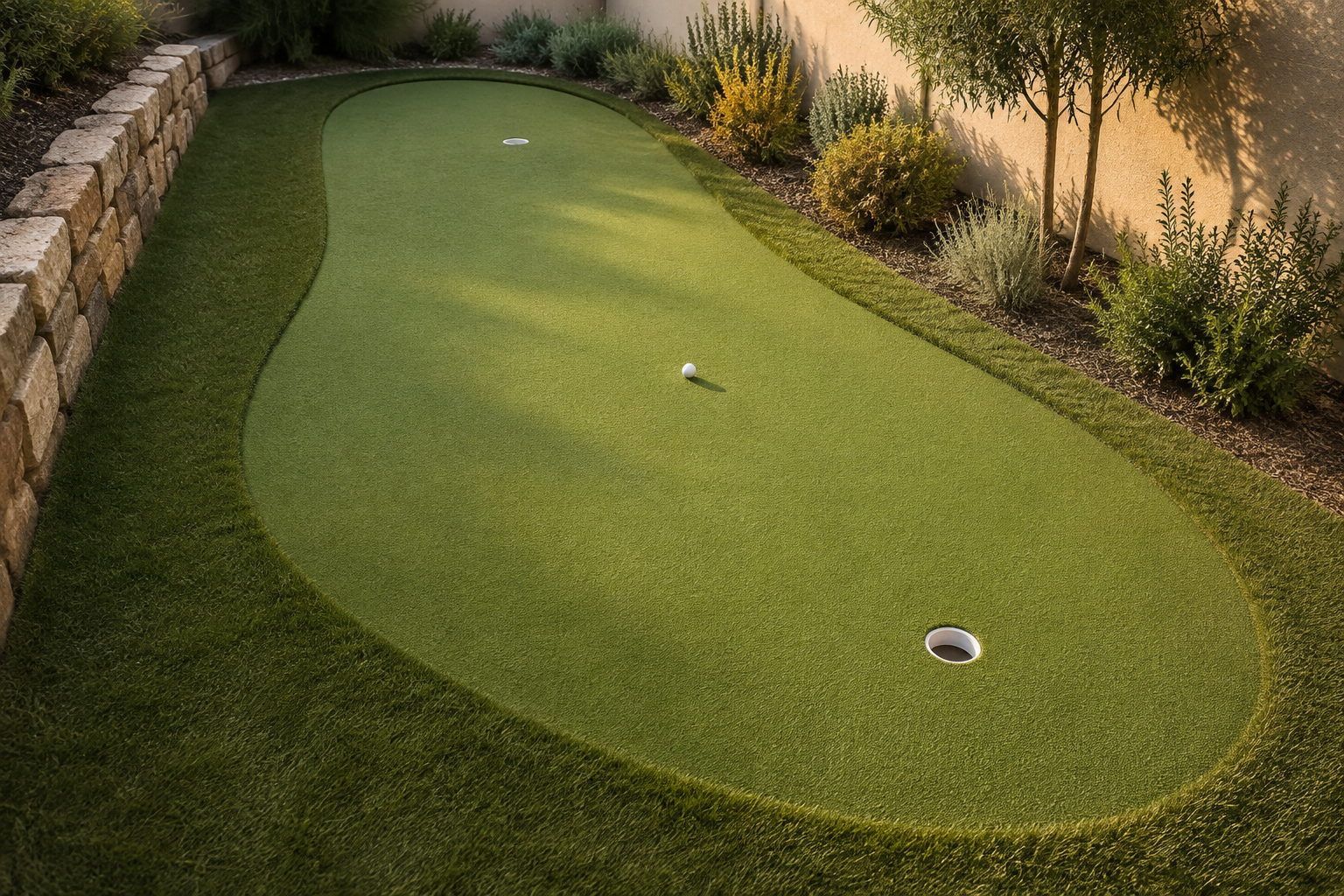
Nylon or polyamide fibres tend to be firmer and more resilient than polyethylene or polypropylene. They often appear in putting surfaces, sporting applications or areas that need a more rigid fibre, including backyard and commercial golf greens.
Nylon can feel less like a soft residential lawn underfoot and may cost more than the alternatives. Its actual performance still depends on the complete turf construction, not the yarn material alone.
| Blade Material | Typical Feel | Common Applications | Potential Strength | Potential Limitation |
|---|---|---|---|---|
| Polyethylene | Soft to moderately firm | Residential lawns, landscaping and family areas | Natural-looking and comfortable underfoot | Quality varies across yarn shapes and specifications |
| Polypropylene | Light and variable | Thatch, backing and selected surface applications | Versatile and generally economical | May offer less resilience in some face-yarn designs |
| Nylon or polyamide | Firm | Putting surfaces, specialised turf and high-wear applications | Strong recovery and stiffness | May feel less natural and cost more |
| Blended yarn | Product dependent | Multi-purpose landscaping systems | Combines different material characteristics | Buyers need to check which material is used in each layer |
The Synthetic Turf Council advises buyers to be wary of blanket claims against any single yarn polymer, since polyethylene, polypropylene and nylon can each be engineered for strength, colour retention, UV resistance and moisture resistance.
A short quality checklist is worth working through before you compare products:
- Fibre or yarn material
- Blade shape
- Fibre thickness
- Pile height
- Stitch rate and density
- Face weight
- Thatch construction
- UV stabilisation
- Tuft-retention strength
- Backing and drainage design
- Warranty terms and exclusions
- Intended application
Pile height alone does not indicate quality. A tall but sparse turf can perform quite differently from a shorter, denser product, which is one reason our guide to comparing different types of artificial grass turf looks at pile height, density and blade shape together rather than as separate ratings.
How Are Synthetic Grass Backing and Fibres Manufactured?
Synthetic grass is generally manufactured by forming polymer into yarn, tufting that yarn through a primary backing and applying a secondary coating to hold the fibres in place. The finished turf is then cured, perforated or made permeable, trimmed and rolled for transport.
- Polymer preparation. Polymer pellets are combined with pigments and product-specific additives.
- Yarn extrusion. The heated polymer is pushed through shaped openings to form thin strands or film.
- Cooling and finishing. The yarn is cooled, stretched, textured or curled according to the intended blade or thatch design.
- Tufting. Machines insert rows of yarn through a primary backing, in a process similar to carpet manufacturing.
- Secondary coating. A latex, polyurethane or other coating is applied to the underside to help hold the tufts.
- Curing. The backing passes through a controlled heating or drying stage so the coating can set.
- Drainage preparation. The backing may be perforated or manufactured with a permeable structure, depending on the product.
- Cutting and finishing. The turf is inspected, trimmed to width and rolled for distribution.
This is a general manufacturing sequence. Exact materials, machinery, coatings and quality-control processes vary between manufacturers.
| Backing Type or Element | Description | Practical Consideration |
|---|---|---|
| Woven primary backing | A fabric layer through which yarn is tufted | Should remain stable and retain the tufts |
| Multiple primary layers | Two or more fabric layers are used for added stability | May reduce movement, but construction varies |
| Latex coating | Flexible coating used to secure yarn | Performance depends on formulation and manufacturing |
| Polyurethane coating | Polymer coating used to hold tufts | Often selected for bond strength and dimensional stability |
| Perforated backing | Drainage holes added at intervals | Holes must align with a suitable draining base |
| Fully permeable system | Designed to allow water through a broader area | Performance still depends on installation and site drainage |
Backing weight or the number of layers should not be assessed in isolation. Bond strength, flexibility, drainage, dimensional stability and how well the system suits the site are all relevant, which is why our residential installation process pairs each product with a base and drainage design matched to the property.
How Do Materials Affect Synthetic Grass Quality and Durability?
Material type matters, but it is only one factor in how a turf performs. Two polyethylene products can behave quite differently due to differences in fibre thickness, density, tufting, backing strength, installation quality, and sun exposure.
| Quality Factor | Why It Matters | What to Ask the Supplier |
|---|---|---|
| Yarn polymer | Influences on feel and fibre behaviour | Which materials are used in the face yarn and thatch? |
| Blade shape | Affects appearance and recovery | How is the blade designed for the intended traffic level? |
| Density | Influences coverage and surface feel | What are the stitch rate and face weight? |
| UV stabilisation | Helps the product cope with sunlight exposure | What does the warranty say about fading and UV exposure? |
| Tuft retention | Reduces premature fibre loss | Is tuft-bind or pull-out information available? |
| Backing stability | Helps the roll retain its dimensions | What backing and secondary coating are used? |
| Drainage | Controls how water moves through the system | Is the backing perforated or fully permeable? |
| Base preparation | Supports stability and water movement | What base is recommended for this site? |
| Installation quality | Affects seams, edges and finished appearance | Who installs the turf, and what workmanship warranty applies? |
| Maintenance | Helps control debris, flattening and odours | What cleaning and brushing does the product require? |
Before comparing products, it helps to work through a short checklist:
- Identify how the area will be used.
- Estimate foot traffic
- Check whether pets will use the surface.
- Consider direct sunlight and reflected heat.
- Confirm how water will drain from the site.
- Compare complete product specifications.
- Ask for a physical sample.
- Review the written warranty.
- Ask whether installation is included.
- Confirm cleaning and maintenance requirements.
- Request available product testing or certification
- Ask about repair, removal and end-of-life options.
For more on what specifically affects turf lifespan, see our guide on how long artificial turf lasts.
Environmental and End-of-Life Considerations
Synthetic grass can reduce mowing and eliminate the need to water the surface as with a living lawn, but it remains a manufactured, plastic-based system. Its overall environmental impact depends on its materials, lifespan, installation, maintenance, and its fate after removal.
- Plastic fibres do not biodegrade like natural grass.
- Worn fibres and loose infill need to be contained where practical.
- Surface temperatures can rise well above air temperature in direct sunlight; a University of Melbourne study measured artificial turf reaching surface temperatures of up to 71.6°C in backyard conditions over a Melbourne summer, hot enough to pose a skin-burn risk for several hours of the day, in research comparing artificial and natural turf.
- Mixed polymers, coatings, adhesives and contamination can make recycling difficult.
- Recycling availability varies by product and location.
- Removed turf should not be assumed to be accepted through household recycling.
- Buyers can ask suppliers about take-back or end-of-life programs.
- A longer-lasting, repairable installation may reduce the frequency of replacement.
Synthetic grass is not automatically environmentally beneficial or harmful in every situation. The details of the specific product, site, and use matter more than a blanket claim in either direction. If heat is a particular concern for your project, our article on whether artificial turf gets hot in the Australian summer covers practical ways to manage it.
The answer to what synthetic grass is made of goes beyond the visible blades. A complete product may include polyethylene, polypropylene or nylon yarn, curled thatch, a primary backing, a secondary coating and, in some cases, infill.
Buyers get the best result by comparing the full specification rather than a single material name. Intended use, drainage design, warranty terms and installation method all affect how a turf performs in a particular yard, and material names alone do not decide whether a product is the right fit.
Ready to Compare Your Options?
Tell us how the area will be used, its expected traffic, drainage, sun exposure and preferred surface feel, and we can help you compare products and recommend a system suited to your site, whether you are on the Central Coast, in Sydney or across greater NSW.
Frequently Asked Questions
Is synthetic grass made from plastic?
Yes. Most products use polyethylene, polypropylene, nylon or a combination of these polymers for the visible blades. At the same time, the backing, secondary coating and some infill materials may also contain plastic-based components. The exact construction varies between manufacturers, so it is worth confirming the specific materials through the product specification sheet before you buy, rather than assuming every synthetic grass product is built the same way.
What material is used for artificial grass blades?
Polyethylene is common in residential lawn products; polypropylene appears in some blades and thatch; and nylon is used where firmer or more resilient fibres are desired. No single material is automatically the best choice for every application. The right blade material depends on how the area will be used, expected foot traffic and the look and feel you are after.
What is the backing of synthetic grass made of?
The primary backing commonly uses woven or non-woven polypropylene or a related fabric. A secondary latex, polyurethane or product-specific coating is then applied to secure the tufted fibres in place. Drainage may be provided through perforations spaced across the backing or through a broader permeable design, so it is worth confirming which approach a specific product uses before you buy.
Is synthetic grass safe for pets and children?
This depends on the specific product, installation, maintenance and intended use, so it is worth asking for relevant product documentation rather than assuming universal safety. Check surface temperatures before use, maintain good drainage, and clean pet areas regularly. If turf will be installed beneath play equipment, it needs to meet the impact-attenuation requirements set out in the AS/NZS 4422 playground surfacing standard, since turf on its own is not certified as fall protection. Our guides on playground soft fall and artificial grass for dogs cover this in more depth.
Can synthetic grass be recycled?
Some components may be recyclable, but recycling a complete roll of turf can be difficult because it often combines several polymers, backing coatings, adhesives, sand and contamination picked up during use. Check local disposal rules and ask the supplier whether a suitable recovery or take-back option is available before you commit to a purchase.
Recent Posts